 Synvolve Solutions
An AI agent for manufacturing is a software solution that automates complex production tasks, streamlining operations while enhancing efficiency and quality. By integrating with leading ERP systems such as SAP, Oracle, or Microsoft Dynamics, manufacturers can automate order management, inventory tracking, and production scheduling—improving visibility and agility across the entire production process. This approach optimizes resource use, reduces errors, and helps maintain high standards in today’s competitive manufacturing landscape.
What Is an AI Agent and How Does It Work in Manufacturing?
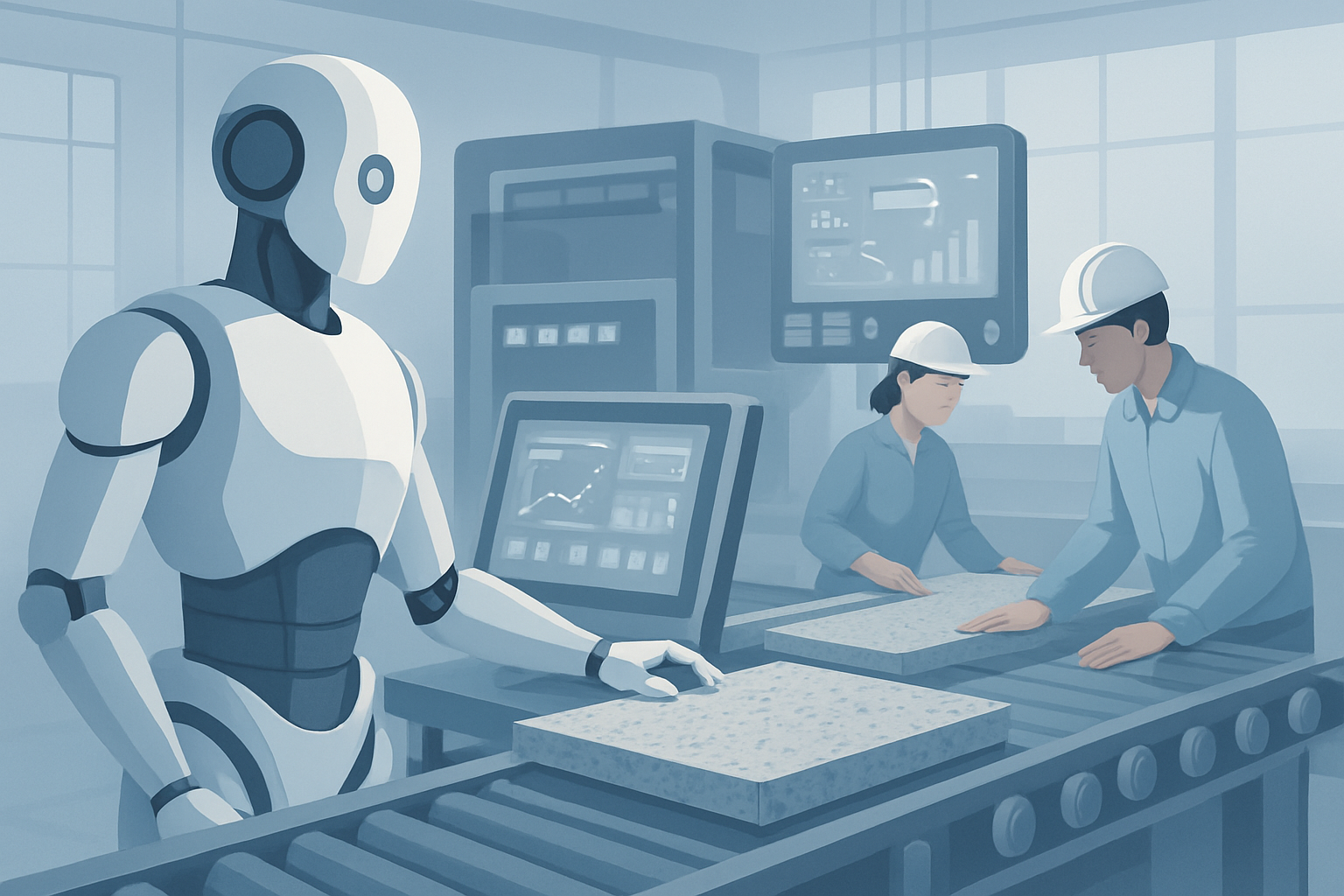
An AI agent is a software-driven tool that autonomously executes tasks, makes decisions, and optimizes manufacturing workflows—without constant human oversight. Unlike traditional automation, which relies on static rules, an AI agent for manufacturing processes real-time data, identifies patterns, and predicts optimal actions. For instance, in granite manufacturing, an AI agent might track raw materials, optimize logistics, or forecast equipment maintenance needs.
When connected to ERP systems like SAP, Oracle, or Microsoft Dynamics, an AI agent can automate repetitive tasks: processing orders, allocating resources, and generating purchase requisitions. By learning from historical data and adapting to business changes, the AI agent continuously refines operations—improving efficiency and responsiveness.
How AI Agents Differ from Traditional Automation
Traditional automation relies on fixed rules and requires manual reprogramming for changes. In contrast, an AI agent for manufacturing learns from new data, adapts to evolving conditions, and autonomously finds process improvements. This results in faster market response, fewer errors, and greater efficiency across production cycles.
Key Challenges and Opportunities in Manufacturing Automation
Manufacturing environments—whether in granite, metals, or plastics—are made up of interconnected workflows, each with unique requirements and data streams. Standard ERP systems often lack the flexibility to address every specialized need, such as tracking block inventory or managing real-time logistics in granite production.
Custom business process automation with AI and AI agent deployment address these gaps, integrating seamlessly with your existing ERP and MES platforms.
Common Challenges in Advanced Manufacturing Automation
- Complex Inventory Management: Managing raw materials, waste, and byproducts often requires custom solutions beyond standard ERP modules.
- Multi-Channel Order Management: Orders from various sources need automated, channel-specific processing and documentation.
- Quality Control & Compliance: Tracking parameters like material grades and defect rates is essential for pricing and regulatory compliance.
- Supply Chain & Logistics: Coordinating shipments and documentation is critical for smooth delivery and regulatory adherence.
Efficiency Gains Through AI-Driven Process Automation
AI agents for manufacturing deliver:
- Reduced Human Error: Automation ensures precise material tracking and minimizes data entry mistakes.
- End-to-End Visibility: Real-time monitoring of every production step creates a transparent supply chain.
- Customization: Solutions adapt to unique workflows, such as dynamic routing or special quality checks.
- Actionable Analytics: Aggregated data highlights bottlenecks and guides resource allocation.
- Scalability: Automated systems grow with your production needs, from small batches to global operations.
{{IMAGE_N}}
Why Integration with Leading ERP Systems Matters
An AI agent for manufacturing connects with ERP systems like SAP, Oracle, Microsoft Dynamics, Infor, or NetSuite—the central platforms for managing inventory, work orders, finances, and operations. Accurate, timely ERP data is crucial for production continuity and cost control.
Integrating an AI agent with your ERP enables real-time, autonomous actions: generating material requisitions, triggering approval workflows, or dynamically optimizing schedules without manual intervention.
Key ERP Modules Enhanced by AI Agents
| ERP Module | AI Automation Capabilities | Manufacturing Impact | Integration Example |
|---|---|---|---|
| Inventory Management | Automated material requisition | Minimizes shortages and downtime | Auto-generate purchase orders on low stock |
| Production Planning | Dynamic schedule optimization | Maximizes line utilization | Recalculate schedules for new work orders |
| Supply Chain / Logistics | Intelligent route and shipment selection | Reduces delivery lead times | Automated carrier selection & shipment setup |
| Financial Management | Real-time spend monitoring | Controls overspending | Auto-approve payments within set thresholds |
Step-by-Step Guide: Implementing an AI Agent for Granite Manufacturing
Preparation: Assessing Readiness for AI Automation
Begin with a thorough audit of your current workflows. Document every production step, focusing on manual interventions and bottlenecks. Identify key KPIs—such as turnaround time, scrap rate, and logistics costs—to guide your AI agent development.
Project Timeline: 8 Weeks to MVP
Developing a minimum viable product (MVP) AI agent for granite manufacturing usually takes about eight weeks. The initial focus is on ERP integration (e.g., SAP, Oracle), syncing inventory, automating work order tracking, and generating real-time reports. Pilot the solution on high-impact workflows, such as inventory control or order generation.
Training your team occurs alongside testing, ensuring staff are comfortable with the new system. Start with a single process, then expand as you validate results and gather operational feedback.
Implementation Checklist:
- Complete process audit and documentation
- Define KPIs for each production stage
- Select an AI architecture aligned with your goals
- Integrate with ERP (SAP, Oracle, Microsoft Dynamics, etc.) and related systems
- Build and validate an MVP AI agent
- Train your team using real scenarios
- Deploy the AI agent without disrupting operations
- Scale the solution after successful piloting
- Establish continuous monitoring and optimization
Case Study: Streamlining Order Management and Inventory in Granite Manufacturing
Synvolve Solutions partnered with a granite manufacturer to deploy an AI agent for manufacturing, integrating it with their ERP (SAP), CRM, email, and website. Incoming orders were automatically captured, validated, and registered as work orders. The AI agent checked inventory, reserved materials, and triggered restocking when needed.
Integration Architecture: AI Agent + ERP
Orders from any channel were funneled into the ERP. The AI agent parsed specifications, verified accuracy, calculated optimal production routes, and generated production tasks. Automated status updates and material shortage alerts saved up to two hours per order in administrative work.
Automated Processes
- Order intake and validation
- Generation of technical requirements and work orders
- Real-time inventory sync and material reservation
- Automated follow-up tasks and production scheduling
- Customer notifications and feedback
Order processing times dropped by 30%, and documentation errors by 40%. Full deployment took eight weeks, with no production downtime. Synvolve Solutions has delivered over 50 similar automation projects worldwide.
Measurable Impact: KPIs and Business Results
After implementing an AI agent for manufacturing, track key performance indicators (KPIs): work order processing time, error rate, equipment utilization, and cost per order. Benchmark your baseline for three months before automation, then compare post-launch results.
With effective AI automation and ERP integration, manufacturers typically see order processing times cut by 2–3x, error rates reduced by 70%, and equipment utilization rise to 85–95%.
KPI Comparison: Pre- and Post-Automation
| KPI | Pre-Automation | Post-Automation | Business Benefit |
|---|---|---|---|
| Work Order Processing Time | 4–8 hours | 1–2 hours | 2–4× faster turnaround |
| Monthly Error Rate | 20–30 errors | 5–8 errors | 70–80% fewer mistakes |
| Cost per Order | 100% (baseline) | 65–80% of baseline | Up to 35% cost savings |
| Equipment Utilization | 60–70% | 85–95% | Higher operational efficiency |
| Avg. Customer Response Time | 3 hours | 30 minutes | Faster service, greater loyalty |
These KPIs provide clear evidence of the value delivered by manufacturing process automation with AI.
Supporting and Scaling Your AI Agent
Once your AI agent for manufacturing is live, ongoing support and strategic scaling are essential. Real-time performance monitoring helps you quickly identify and resolve workflow issues. Automated alerts ensure rapid response to incidents, minimizing downtime.
Continuous improvement is crucial. Regularly update AI models and automation scenarios—ideally every 2–4 weeks—to keep your solution aligned with evolving needs.
Scaling AI automation requires a methodical approach. Stress-test your system, expand infrastructure as needed, and roll out to new lines incrementally—pilot, refine, then expand.
Practical Tips for Scaling
- Centralized Analytics: Use unified dashboards to monitor KPIs and scaling effectiveness.
- Modular Architecture: Keep the AI agent’s core separate from production-specific modules for flexible integration and easy updates.
- Tiered Support Plans: Define support levels by SLA—critical incidents addressed within an hour, routine updates during off-peak times.
Key Takeaways
- Audit your manufacturing workflows to identify bottlenecks where an AI agent for manufacturing can add value.
- Integrate your AI agent with your core ERP (SAP, Oracle, Microsoft Dynamics, NetSuite, etc.) for end-to-end automation.
- Tailor automation to your specific needs, such as complex inventory tracking or multi-channel order management.
- Roll out in phases—start with an MVP, scale up, and monitor KPIs at every stage.
Implementing an AI agent alongside your ERP is the fastest way to reduce manual errors, gain operational transparency, and boost agility. Assess your processes and set clear automation goals to guide your digital transformation.
Frequently Asked Questions
What new capabilities does an AI agent provide in granite manufacturing after BAS ERP integration?
An AI agent integrated with BAS ERP automates routine tasks, optimizes workflows, and provides real-time insights—resulting in faster order processing, reduced errors, and better inventory and resource management.
What risks might arise when implementing an AI agent in manufacturing?
Potential risks include data security concerns, integration disruptions, and staff resistance. Careful planning, strong cybersecurity, and comprehensive training help ensure a smooth transition.
Can an AI agent be customized for unique business processes in granite manufacturing?
Yes, AI agents can be tailored to fit specific workflows and industry requirements, ensuring seamless integration and optimal efficiency.
What are the IT infrastructure requirements for deploying an AI agent with BAS ERP integration?
You’ll need a stable network, adequate server capacity, secure data storage, and robust cybersecurity. Seamless connectivity between ERP and manufacturing systems is essential for real-time automation.
How can the economic impact of AI agent implementation in granite manufacturing be measured?
Track KPIs such as reduced processing times, lower costs, improved equipment utilization, and fewer errors to quantify efficiency gains and return on investment.