 Synvolve Solutions
If you’re considering custom chatbot development for your plastic manufacturing business, the benefits are clear: a tailored chatbot, integrated with your ERP system—such as SAP, Oracle, Microsoft Dynamics, or NetSuite—can automate repetitive tasks, streamline order processing, track raw material inventory, and reduce human error. With robust API integrations and a focus on data security (GDPR, CCPA compliance), a custom chatbot accelerates internal communication and turns real-time plant data into actionable insights. Manufacturers often see measurable ROI—reduced downtime, lower labor costs, and improved productivity—within months of implementation. This approach enables plastic manufacturers to achieve operational efficiency and business goals with minimal risk and maximum scalability.
What Business Challenges Does a Chatbot Solve for Plastic Manufacturing?
A custom chatbot designed for plastic manufacturing addresses key automation and process optimization challenges. By reducing manual intervention and enhancing transparency throughout the order lifecycle, chatbot solutions deliver significant operational value.
Typical Processes Ready for Automation
- Order Intake & Processing: Chatbots capture customer orders, create requests in your CRM or ERP (SAP, Oracle, Microsoft Dynamics), and notify teams instantly.
- Internal Communications: Real-time updates on production schedules, inventory, or task statuses keep plant staff aligned and reduce information silos.
- Production Monitoring: Chatbots pull live data from manufacturing lines, flag deviations, and trigger alerts on equipment failures or bottlenecks.
- Data Collection & Reporting: They aggregate metrics on efficiency, downtime, and raw material usage, preparing actionable reports for management.
- Reducing Human Error: Automating repetitive workflows minimizes data entry mistakes and ensures reliable information flow.
Key Business Benefits
- Faster Order Processing: Automation can cut order handling time by up to 40%, improving fulfillment and customer satisfaction.
- Instant Downtime Alerts: Immediate notifications reduce the risk of prolonged downtime and material losses.
- Centralized Communication: Consolidating updates and requests can save managers up to two hours per day.
- Seamless ERP/CRM Integration: Chatbots connect directly with cloud-based systems like NetSuite or Salesforce, with no production disruption.
- Actionable Analytics: Systematic data analysis pinpoints bottlenecks and highlights opportunities for process improvement.
With these advantages, AI-powered chatbots help plastic manufacturers adapt rapidly to market demands and serve as a foundation for ongoing efficiency gains.
Custom Chatbot Development: ERP Integration, Scenarios, and Security
Understanding how custom chatbot development integrates with ERP platforms like SAP, Oracle, Microsoft Dynamics, or NetSuite is key to a successful project.
Common Integration Scenarios
For manufacturing, chatbot integration with ERP systems typically covers order tracking, inventory control, and real-time production monitoring. For example, a chatbot can let managers check order status, view on-hand inventory, or trigger approvals and notifications—all within a familiar messaging interface. Modern ERP systems provide APIs (REST, SOAP, OData) for data exchange, but their availability and responsiveness depend on your ERP’s version and security setup.
Challenges may arise with highly customized or restricted ERP deployments, which can increase development timelines and require additional backend work. For more on how chatbot development supports ERP integration in manufacturing, see our dedicated service page.
Security and Regulatory Compliance
Security is critical when integrating chatbots with ERP systems. Define which roles access sensitive data, how information is encrypted, and who can authorize critical operations. Best practices include access auditing, two-factor authentication, and comprehensive activity logging.
Compliance with GDPR, CCPA, SOC2, or ISO 27001 is essential, especially when handling personal or financial data. Secure data storage, preventing leaks, and shielding APIs from unauthorized access are must-haves. While upgrading ERP APIs may add costs, these investments are vital for secure, future-proof automation.
Key Stages in Custom Chatbot Development for Plastic Manufacturing
Once technical requirements are clear, here’s how to launch a tailored chatbot solution for plastic manufacturing:
Preparation Phase
- Process Analysis & Goal Setting: Map workflows, identify integration points, and outline key scenarios (order tracking, inventory checks, shift handover).
- MVP Creation: Build a lean chatbot to validate core scenarios, including dialogues, processing logic, and user roles.
- ERP/CRM Integration: Use APIs to connect the chatbot with platforms like SAP, Oracle, Microsoft Dynamics, or NetSuite.
- Testing & Optimization: Simulate real use cases, resolve bugs, and gather feedback to fine-tune the chatbot.
Go-Live and Enablement
- Staff Training & Phased Launch: Train teams, provide user guides, and support initial rollout—starting with select lines or functions before scaling.
- Ongoing Support & Enhancement: Maintain rapid-response support, gather analytics and feedback, and drive continuous improvement.
For a deep dive into chatbot development for ERP systems, including case studies, see our resource.
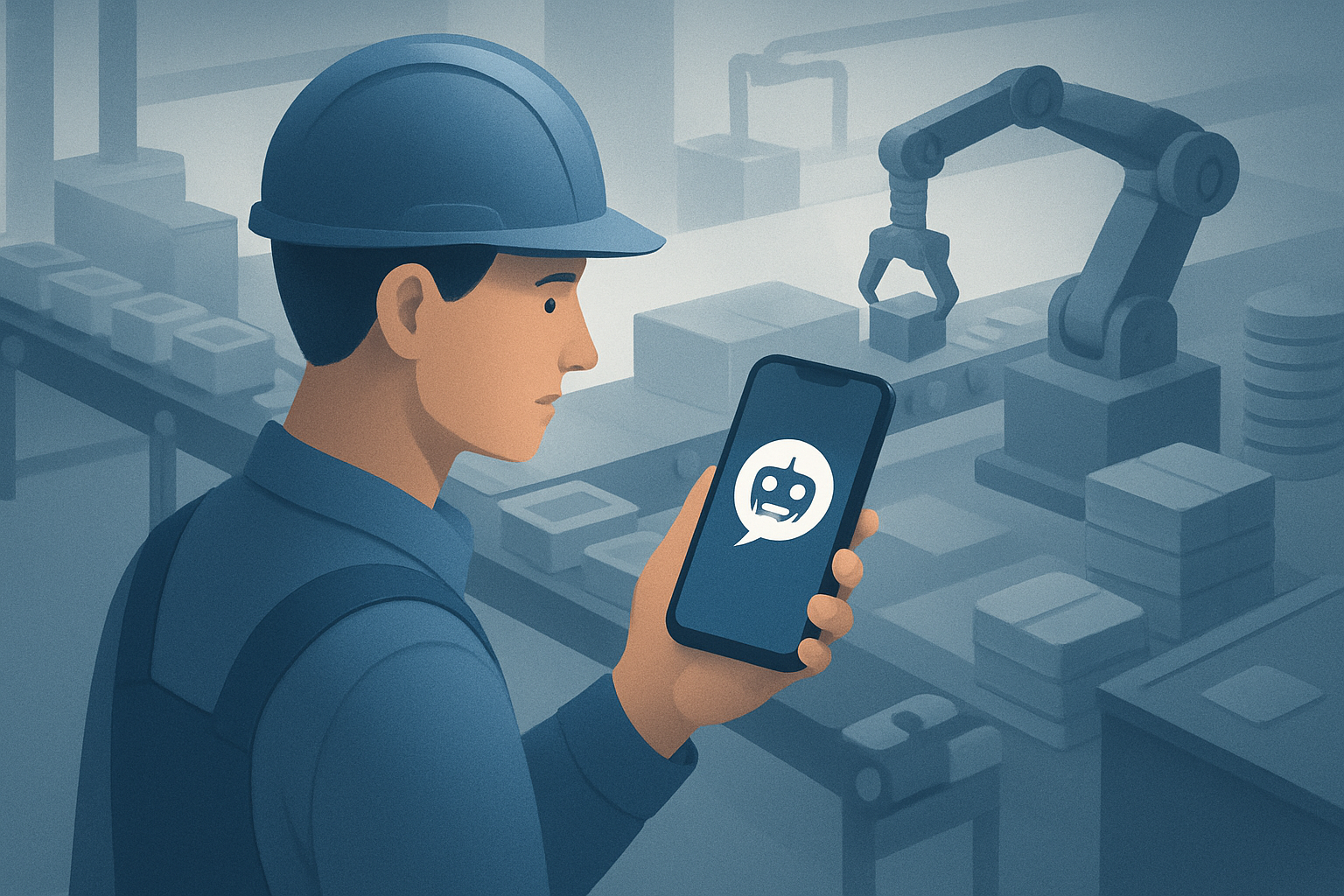
Practical Example: Chatbot Implementation in Plastic Manufacturing
Before Implementation
A mid-sized manufacturer processed up to 80 orders daily, relying on manual entry and phone calls. Lead time from request to confirmation averaged 2.5 hours. Data entry errors affected 12% of orders, causing added costs and delays. Lack of real-time inventory visibility increased downtime risk.
After Implementation
A custom chatbot integrated with the ERP system reduced the order cycle to 25 minutes, with error rates dropping to 1.5%. The process became fully automated, leading to a 70% reduction in operational time spent on order handling.
Within 9 months, ROI reached 185%. Manual processing costs fell by 53%, and team productivity increased by 35%. The deployment fit existing IT and compliance requirements (GDPR, SOC2) without disrupting plant operations.
Measuring the ROI of a Manufacturing Chatbot
Evaluating the impact of a chatbot is essential to ensure your investment delivers results.
Key Metrics to Track
Focus on order processing time, error rates, and workforce costs. For example, automation can cut order processing from 2.5 hours to 30 minutes, and reduce error rates from 5% to 1%. Labor costs per unit typically drop by 20–40%.
ROI formula: ROI = (cost savings + incremental profit – implementation cost) / implementation cost × 100%
Steps:
- Benchmark baseline metrics before deployment.
- Measure the same metrics post-launch.
- Calculate the difference to determine value delivered.
If a chatbot reduces labor costs by $100,000 per year, and development costs $250,000, first-year ROI is: ($100,000 – $0) / $250,000 × 100% = 40%
ROI Assessment Checklist
- Measure processing time per order before and after rollout.
- Document error rates pre- and post-implementation.
- Compare personnel costs before and after automation.
- Tally all deployment costs.
- Apply the ROI formula.
- Track performance trends for 3–6 months post-launch.
{{IMAGE_N}}
Custom Chatbot Development vs. Off-the-Shelf Solutions
Choosing between custom chatbot development and SaaS chatbots shapes your outcome.
Custom chatbots are built for your workflows, aligning logic with industry-specific needs. Off-the-shelf SaaS bots offer limited flexibility and shallow ERP integration. Custom solutions enable you to scale, adapt integrations, and receive personalized support.
Comparison Table: Custom vs. Off-the-Shelf Chatbots
| Criteria | Custom Development | Off-the-Shelf SaaS Solution | Notes |
|---|---|---|---|
| ERP Integration | Full, any complexity | Limited—typically via API | Essential for manufacturing |
| Workflow Flexibility | Maximum | Fixed logic | Direct impact on ROI |
| 3-Year Total Cost of Ownership | Stable/slower growth | Can escalate due to subscriptions | Depends on scale and usage |
| Scalability | Unlimited | Restricted by vendor platform | Critical as your operations grow |
| Support & Evolution | Personalized | Standard, vendor-dependent | SLAs tailored to your needs |
Common Pitfalls in Manufacturing Chatbot Automation
Avoid these frequent mistakes to maximize ROI and efficiency:
- Insufficient Process Analysis: Map every workflow touchpoint to avoid automation gaps.
- Weak ERP Integration: Ensure deep, real-time connectivity with ERP systems.
- Overlooking Security and Compliance: Meet GDPR, CCPA, and other standards with encryption, access logs, and audits.
- Neglecting Ongoing Support: Set clear SLAs and feedback loops for continuous improvement.
- Choosing Generic Solutions: Invest in tailored development for complex manufacturing needs.
Expert Tips: Post-Launch Support & Continuous Improvement
Launching a custom chatbot is just the start. Ongoing value requires robust support and development.
Monitor interaction logs, usage patterns, and errors. Schedule monthly audits of chatbot dialogues. Use feedback to refine flows and address recurring issues.
For ERP integrations, test thoroughly after every system or API update. Automated regression tests and version-controlled scripts are best practice.
Gather feedback via chatbot surveys and review support tickets for new automation opportunities. As your plant evolves, update the chatbot to match workflow and compliance changes.
Consistent support and proactive development drive long-term ROI and help your team maximize automation benefits.
{{IMAGE_N}}
Key Takeaways
- Integrating a custom chatbot with your ERP system automates vital workflows—order processing, shift management, and real-time monitoring—reducing human error and speeding up operations.
- Secure API data exchange, access auditing, and compliance with GDPR or CCPA are essential for dependable automation in plastic manufacturing.
- Implementation covers process analysis, MVP development, ERP integration, QA testing, employee onboarding, and continuous improvement.
- Case studies show chatbot solutions can cut up to 70% of operational processing time, with ROI often exceeding 180% in the first year.
If your factory seeks a smarter digital transformation path, investing in custom chatbot development with direct ERP integration can be a game changer. Reach out to Synvolve Solutions for tailored advice and accelerated manufacturing efficiency.
Frequently Asked Questions
What additional benefits does a chatbot offer plastic manufacturing beyond 1C integration?
A chatbot automates order processing, provides real-time production updates, improves interdepartmental communication, and reduces manual data entry errors, beyond what 1C integration alone can offer.
How can a chatbot be scaled for multiple manufacturing sites?
Scalability is achieved with modular architecture, cloud deployment, and centralized management tools—ensuring consistent performance across all facilities.
How is chatbot maintenance and updates handled after deployment?
Maintenance involves regular monitoring, updating integrations, fixing bugs, and adding features—managed via a support contract or in-house IT team for continuous improvement.
What risks are involved in integrating a chatbot with 1C, and how can they be minimized?
Risks include data security vulnerabilities, incompatibility, and process disruptions. Minimize them with secure APIs, thorough testing, and experienced integration specialists.
Can a chatbot connect to systems other than 1C, and what are the advantages?
Yes, a chatbot can connect to other ERP or MES systems like SAP or Oracle, enabling broader automation, unified data access, and improved workflow coordination.