 Synvolve Solutions
If you’re considering AI assistant solutions for your business in 2026, you’re likely weighing the benefits of AI assistants versus AI agents. The right choice depends on your workflows and growth plans. AI assistant solutions are designed to streamline routine tasks and boost productivity—think scheduling, reminders, or handling simple queries—within platforms like Salesforce, HubSpot, or Google Workspace. AI agents, on the other hand, operate autonomously, executing complex tasks and transforming business processes with minimal human oversight. Choosing the right approach will shape your company’s flexibility, customization, and scalability. This article breaks down the differences, explores integration with leading SaaS and CRM/ERP platforms, and covers compliance with GDPR and CCPA.
What Is an AI Agent vs. an AI Assistant?
AI Agent: Definition and Features
An AI agent is an autonomous system that makes decisions and takes actions across complex, often multichannel, business environments. Unlike basic automation, AI agents can proactively manage workflows without ongoing human input. For example, in a CRM like Salesforce or HubSpot, an AI agent can score leads, trigger outreach, and coordinate sales and support. In supply chain management, an agent might analyze inventory, forecast demand, initiate procurement, and optimize logistics—adapting in real time.
AI Assistant: Definition and Features
An AI assistant (or virtual assistant) is a support tool that responds to user requests or follows predefined workflows to handle straightforward tasks. For example, a meeting scheduler integrated with Google Workspace can send reminders and organize appointments, but won’t make strategic decisions or allocate resources. Similarly, a customer support chatbot in Zendesk automates responses to FAQs but doesn’t drive end-to-end process automation.
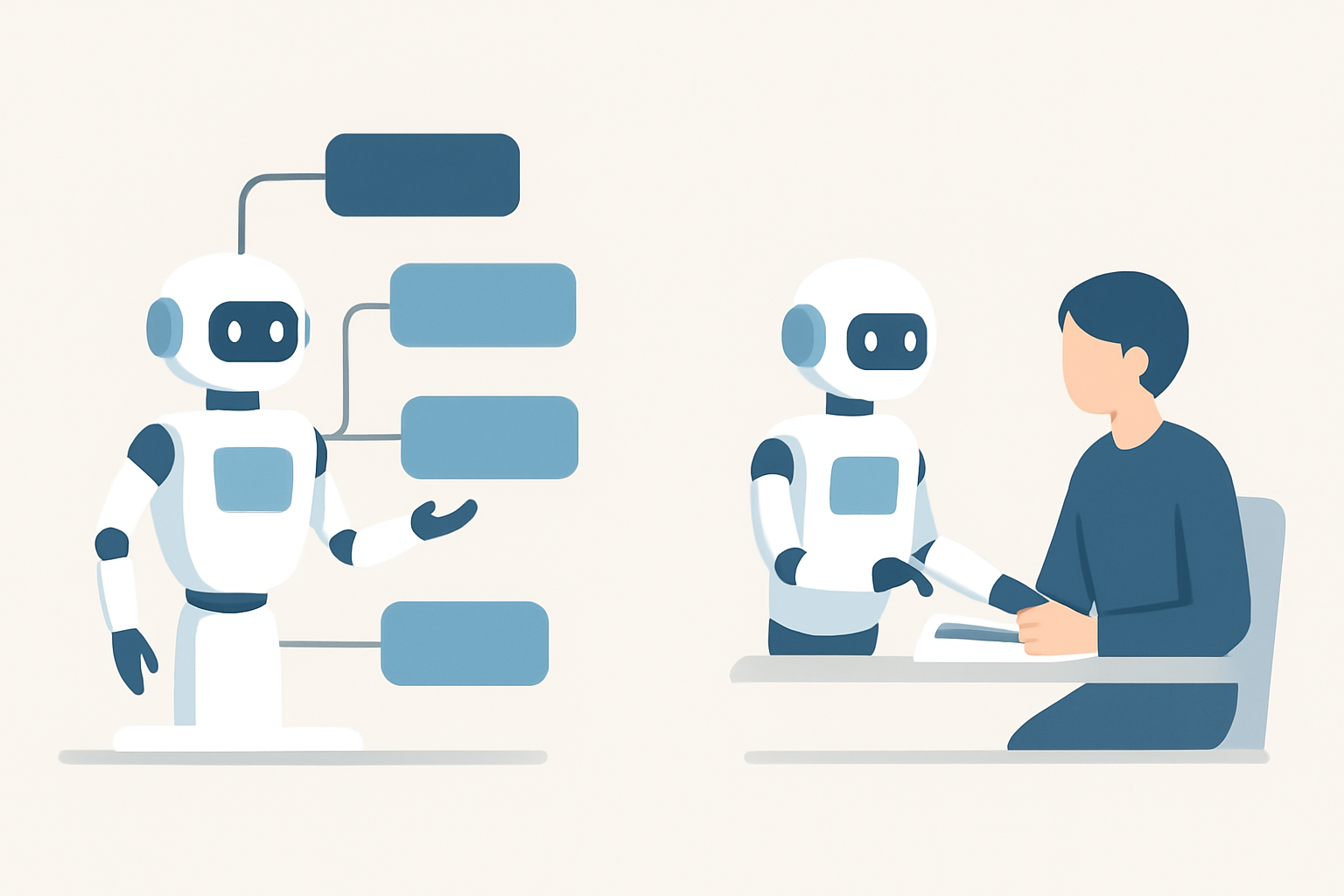
Key Differences Between AI Agents and AI Assistants
Understanding the distinction between AI agents and AI assistant solutions is crucial for making the right choice for your business.
Autonomy and Scalability
AI agents function with high autonomy, making decisions and initiating actions independently. They can manage end-to-end automation, integrating directly with platforms like Salesforce, HubSpot, or Microsoft Dynamics. In contrast, AI assistants operate under user direction, handling specific tasks like sending emails or retrieving information. AI agents are ideal for scaling in complex, multichannel environments, while AI assistants are best for handling routine, repetitive work.
Flexibility and Adaptability
AI agents adapt in real time, learning and evolving workflows through machine learning. This allows them to adjust to operational changes without manual intervention. AI assistants, however, rely on user or developer input to learn and are typically limited to standard integrations. Agents can be customized for unique business needs, while assistants are suited for standard, repetitive tasks.
Comparison Table: AI Agent vs AI Assistant
| Criteria | AI Agent | AI Assistant | Example Use Cases |
|---|---|---|---|
| Core Functions | Autonomous execution, decision-making, deep integration | Guidance, info lookup, scheduling, user support | AI agent—lead processing in Salesforce; AI assistant—meeting scheduling |
| Integration Level | Deep integration, tailored to company needs | Surface-level integration via APIs/connectors | AI agent—logistics in Dynamics; AI assistant—reminders in Slack |
| Multichannel Capabilities | Web, mobile, email, chat, omnichannel automation | Typically single channel or UI extension | AI agent—orders across Shopify/email/Zendesk; AI assistant—emails in Outlook |
| Limitations | Higher implementation complexity | Limited autonomy, depends on user scenarios | — |
| Application Areas | Complex workflows, sales, support, inventory | Employee support, routine admin tasks | — |
This table helps you quickly determine whether an AI agent for business or an AI assistant is right for your automation needs. For end-to-end multichannel automation with platforms like Salesforce or Oracle ERP, AI agents offer full autonomy. AI assistants are best for operational support tasks such as scheduling or document prep.
Typical Use Cases for AI Agents and AI Assistants
- AI Agent (Autonomous Agent):
- Supply Chain: Orchestrate inventory, procurement, and logistics across platforms like Oracle or Dynamics.
- Omnichannel Support: Unify chat, email, and messaging for seamless customer experience on Zendesk or Salesforce.
- Automated Data Analysis: Identify trends, detect anomalies, and generate reports for strategic decisions.
- Dynamic Pricing: Adjust prices in real time based on demand, competitor data, and inventory.
- AI Assistant (Virtual Assistant):
- Scheduling: Integrate with Google Workspace or Outlook to find meeting slots and send reminders.
- Inquiry Handling: Answer FAQs for customers or internal teams, freeing up staff for higher-value work.
- Personal Reminders: Manage deadlines and generate to-do lists.
Choose an AI agent for deep business process automation with AI and systems that adapt to changing conditions. Use an AI assistant for routine tasks that support digital transformation but require minimal contextual analysis. This is especially relevant for US and UK companies, where rapid deployment, integration, and compliance are priorities.
How to Choose Between an AI Agent and an AI Assistant
Selecting the right AI assistant solutions depends on your operations and goals. Use this checklist:
- Task Types: Map your workflows. If you need autonomous automation or proactive task handling, choose an AI agent. For repetitive, routine support, a virtual assistant will suffice.
- Business Scale: Fast-growing or complex companies benefit most from AI agents. Smaller teams often see faster ROI from AI assistants.
- Integration Needs: If your business uses multiple platforms (Salesforce, HubSpot, Oracle, Slack, Google Workspace), custom AI agent development ensures seamless integration.
- Budget and Timeline: Building a minimum viable AI agent takes 12–16 weeks; an AI assistant, 4–6 weeks. Consider the scope and resources.
- Process Complexity: Industries like logistics, e-commerce, and finance may require tailored AI automation. For workflows needing deep customization or regulatory compliance (GDPR, CCPA), prioritize agents.
- Expert Input: Consult a specialist to audit your processes and clarify whether you need an autonomous agent or a virtual assistant.
Trends and Forecasts for AI Agent and Assistant Solutions Through 2026
Staying ahead means not just implementing AI assistant solutions now, but anticipating future trends.
Multichannel Agents in CRM/ERP
By 2026, over 60% of mid-sized companies will have integrated AI with core CRM/ERP systems like Salesforce, HubSpot, Dynamics, and Oracle. The trend is toward deep customization and real-time omnichannel communication. AI agents now orchestrate interactions across email, messaging, chatbots, and mobile apps, unifying operational data across channels.
Economic Impact
Custom AI automation can save 20–40% of staff time on critical processes. For mid-sized firms, a fully integrated AI agent with CRM/ERP typically delivers ROI within 6–12 months. There’s a growing emphasis on ROI analytics, clear metrics, and the ability to scale AI automation without disrupting operations. Expect robust reporting, compliance with GDPR/CCPA, and seamless scaling from future-ready AI solutions.
Real-World Examples of AI Assistant Solutions
Across the US and UK, businesses are realizing measurable gains from AI assistant solutions and autonomous agents:
- E-commerce Support: A global retailer integrated an AI agent with Salesforce and omnichannel platforms (Slack, Zendesk), increasing response speed by 40% and boosting CSAT by 18%.
- Supply Chain Optimization: A logistics firm used a custom AI agent to optimize routes and manage warehouses, cutting costs by 15% and halving delivery delays in three months.
- HR Automation: A tech company implemented an AI assistant for recruitment, integrated with Dynamics and Google Workspace. Time-to-hire dropped from 21 to 14 days.
- Synvolve Solutions Case: For a retail client, Synvolve Solutions built an AI agent in Oracle ERP, automating order processing and reducing manual intervention by 35%, saving nearly two hours per order.
These examples show how AI tools for business process automation transform operations, enhance customer engagement, and streamline workflows—even in highly regulated markets.
Key Takeaways
- Assess process complexity: For advanced, autonomous workflows, choose an AI agent. For automating routine tasks, an AI assistant is usually enough.
- Integration: AI agents are best for deep customization and integration across platforms (Salesforce, HubSpot, Oracle). For standard support via Slack or Google Workspace, a virtual assistant works well.
- Scalability: AI agents learn and adapt with your business. AI assistants follow pre-set scripts and suit predictable processes.
- Match solution to needs: Multichannel or complex automations require AI agent solutions. For high-frequency but simple tasks, AI assistants offer quick wins.
Choose your AI automation based on real business needs—analyze workflows, identify bottlenecks, and implement the solution that delivers the most impact.
Frequently Asked Questions
What are the main business applications of AI agents?
AI agents are used in supply chain management, dynamic pricing, fraud detection, and multichannel customer engagement. Their autonomy allows them to make decisions and act across systems without constant oversight.
Can AI agents be integrated into existing business processes?
Yes. AI agents are designed to work with current software and platforms, often through APIs or custom connectors, enhancing automation and decision-making without major system changes.
Which tasks are best automated by AI agents?
AI agents excel at tasks requiring independent decision-making and real-time responses—such as managing logistics, optimizing inventory, personalizing marketing, and handling complex customer inquiries across channels.
What are the advantages of custom AI solutions over ready-made templates?
Custom AI solutions offer tailored functionality, deeper integration with unique workflows, and scalability. Unlike templates, custom solutions address specific business challenges and adapt as your company evolves.
Should small businesses choose an AI agent or an AI assistant?
Small businesses usually start with AI assistants for routine tasks. However, if operations involve complex decision-making or need high autonomy, investing in an AI agent may yield greater long-term benefits.